Showing posts with label 1940s. Show all posts

Friday, October 16, 2026

Cleburne Cafeteria

Photo from Yelp, "Doug C.", taken in 2012, showing the 1990-2016 incarnation of the restaurant.

3606 Bissonnet Street has been rebuilt twice from what we know of. Home to Cleburne Cafeteria today, the address originally hosted Carter's Lucky 7 (built in the mid-1940s; Lucky 7 was a local grocers co-op) and the 5,400 square foot building later became Gerland's #4 before closing in early 1953. In 1958, the former grocery store was converted to a restaurant, Mexico City Restaurant (probably closer to Tex-Mex), and in 1969 became the new home of Cleburne Cafeteria, which had been previously at 1018 Cleburne since around 1942 (hence the name). In August 1990 the building was destroyed in a fire but was rebuilt and reopened in December 1990. Nearly 26 years later, in April 2016, a fire once again destroyed Cleburne Cafeteria. The restaurant rebuilt and reopened once more in November 2017.

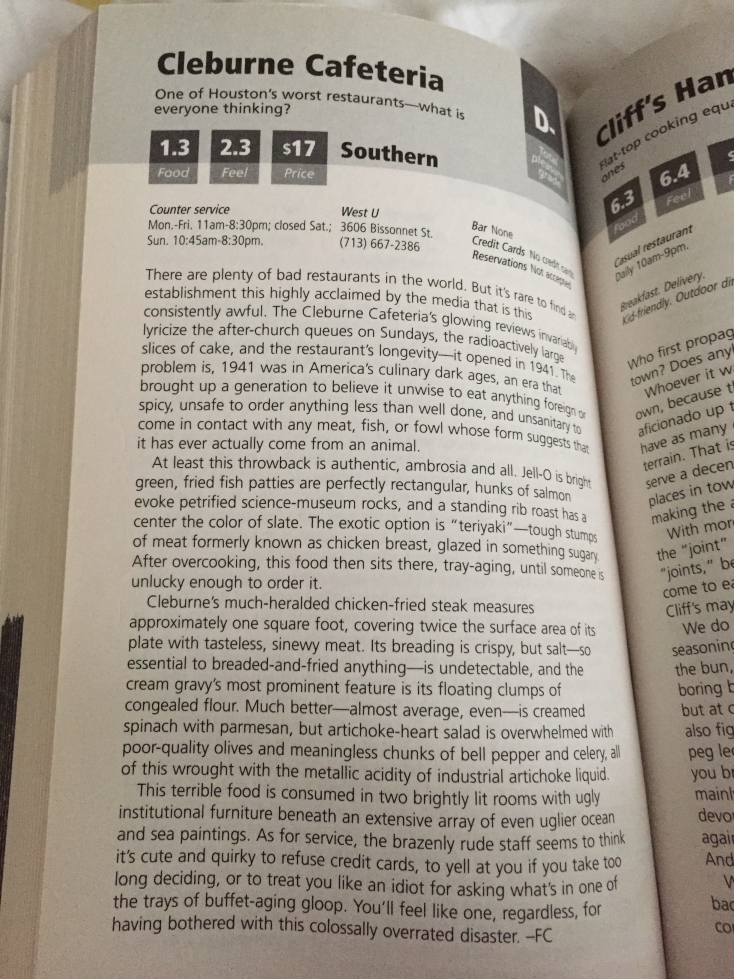
This entry originally appeared on Carbon-izer's Houston entries and in that section, I mentioned a restaurant review guide Fearless Critics a few times before. While I've never eaten at Cleburne Cafeteria myself, they HATED it. Whether they were exaggerating or not, I found their review, which you can see here highly entertaining.

Wednesday, September 16, 2026

Cal-Tex Citrus Juice

As of this writing I can't get a good picture of the site, so we'll just have to go with this 1980 help wanted ad for now.

There's enough "removed from Carbon-izer.com" content to keep this blog going for a while, with this one being taken off back in May 2025 as part of revamping a page to focus exclusively on "Inner Loop" Westheimer Road, 402 Yale Street and newly updated for The Houston Files. While we'll get to the current fate of 402 Yale in a minute, it was built as the new building for Nelson Milk Company (moving from 1331 N. Shepherd) in 1948 but around 1956 it closed and was replaced by Cal-Tex Citrus Juice Inc. in 1957 (moving from 1918 Center), processing 60 tons of oranges (70% from Texas) into Vita-Pakt brand cartons and bottles.1 The company got in trouble a few years later when it was discovered the "pure" orange juice was actually orange juice concentrate, sugar, and water2, but nevertheless the company remained and endured, up until 2012 when it was purchased by Ohio-based Country Pure Foods.

By 2016 the company (still officially "Cal-Tex Citrus Juice LP") hadn't converted fresh oranges to juice in a long time (the hard freezes in Texas winters killed the idea of Texas being a citrus powerhouse decades ago) and instead brought in existing orange juice concentrate (along with apple and grape juice concentrates) and exclusively packaged for institutional and foodservice uses.

I personally visited the building once for an interview and I remembered the main offices were on the second level, accessed by a tight spiral staircase. (Definitely not ADA compliant, but American fire code has disallowed this for decades, and at the time the tragedy at Kyoto Animation, which had similar construction, had not yet happened.

Despite the fact that on the other side of Yale Street (where employee parking was), a railroad connected the MKT line to the north with the Southern Pacific line to the south, 402 Yale had no rail access.3 In early 2025, Country Pure announced it would close the plant and sold the land by the end of the year, with the building demolished by February of next year. It's probably going to be apartments or something similar, as is the usual play in Inner Loop Houston...

1. "Meadowgold" was another brand used.
2. This was an advanced operation by the government, to the point where they were using film cameras and months of surveillance. Several received fines, with the company president being fined and sentenced to six months in jail.
3. While it's been gone since at least the late 1990s, very little of this line remains today except an abandoned bridge at the southwest corner of the eastbound frontage road of I-10 and Yale Street.

Monday, August 10, 2026

Wagner Hardware

From "Liz S." on Yelp from here.

This post was originally part of Carbon-izer.com and later spun off to Numbered Exits, where it was combined with a post on Village Flowery (current Numbered Exits post here.

When it began construction of a building fronting Kirby in May 1948, Wagner Hardware already had been a known name moving from the Rice Village area, and after completing the building at 6111 Kirby Drive, continued to operate for the next 60 years. At one point, Wagner Hardware had six locations in the Houston area. By December 2004, with the closing of their store at 5233 Bellaire Boulevard (which operated since 1953), Wagner was down to this location. In 2009, it introduced a store-within-a-store for eco-friendly products called "New Living". Not too long after, the store changed hands and the store was remerchandised and rebranded to the "New Living" concept. Most of the hardware lines were dropped for furniture and mattresses in addition to paint, and in 2014, New Living dismantled the old Wagner Hardware sign above the store. Between 2015 and 2017, New Living refocused from "sustainable design and furniture" to simply "organic mattresses". I'm not sure how the transition between New Living and Houston Natural Mattress (the similar replacement tenant) occurred, but it happened between October 2019 and March 2020. They had different phone numbers. (Street View here).

Thursday, July 12, 2018

Tejas Materials Inc.

1902 Weber Street

This facility was built in 1948 for Ceco Steel Products Corporation, which relocated from 2814 Pease (the old facility was sold to adjacent to Markle Steel), housing an office, fabrication plant, and warehouse. When Ceco closed the facility is unknown, but in the late 1980s it was leased to Gypsum Management & Supply, which changed names to Tejas Distribution Company, and eventually Tejas Materials Inc., which bought the facility outright from Ceco-Robertson (merger from 1990) in 1993.

Originally, there was a storage yard out back accessible through an extension of Silver Street, but reconfigurations from highway construction would mean that Silver Street was truncated past Weber, and the space to the east of the warehouse used instead. Of interest is an abandoned spur that was cut off in the early 1990s (or even 1980s), connecting to the Katy line and cutting between the buildings owned by Martin Preferred Foods to the south. You can see that some rails still remain just beyond the repaving of the road, with the original Weber surface buried about four inches or so below the current pavement.